




Whenever people talk about root canal treatment, nervousness, doubt and fear set in. But what exactly is a root canal treatment? Let us demystify this procedure by clearly addressing its importance, its indications and the latest advancements in the field.
What is Endodontics?
It is the branch of dentistry dedicated to the study, diagnosis and treatment of the dental pulp, root canals and periapical tissues (surrounding the tooth). The dental pulp (the tooth's nerve) consists of a collection of blood vessels and nerve endings located in the innermost layer of the tooth, extending to the tip of the roots. When there is an alteration/reaction in the dental pulp, there is a hypersensitivity response to cold/heat or even pain. In these cases, it is necessary to perform endodontic treatment (root canal treatment).
What causes the need for endodontic treatment? Several scenarios can alter the dental pulp and justify its treatment:
-
Acute pain due to tooth decay: when tooth decay reaches an advanced stage, the bacteria present reach the pulp and contaminate it (pulpitis), triggering the typical acute toothache. The solution? Endodontic treatment to eliminate the symptoms.
-
Abscess: if the pain is not very severe and treatment is delayed, the dental nerve is slowly contaminated and gradually "dies" (pulpal necrosis). Although there is no pain, the bacteria progress towards the tip of the root, where they begin to trigger an infectious response in the bone (an abscess). This can only be fully resolved if we remove the causal factor that is, the bacteria in the root canals.
-
Periodontitis: the contamination of surrounding tissues, such as the gums and bone, can also be a pathway for bacteria, progressing through the periapical tissues to the roots, where they enter the pulp and damage it.
-
Dental trauma: a bump or fall can cause a tooth fracture, exposing the dental pulp to bacteria. Even if the tooth does not fracture, the trauma can still leave sequelae: due to the impact, the blood supply to the dental pulp can be damaged.
-
Retreatment: in cases where a previous endodontic treatment has failed and/or a new bacterial contamination has occurred, a root canal retreatment must be performed.
Endodontic treatment: pulp removal, disinfection and sealing The first stage of treatment is accessing the pulp, which is done through the crown of the tooth via a small hole that extends to the innermost layer. The second stage consists of removing the pulp and disinfecting the root canals.
Files (thin, flexible instruments) are used to clear the way for disinfecting solutions that will "kill" and eliminate the bacteria causing the infection. Finally, when the tooth is completely disinfected and clean, a biocompatible material is used to seal the roots and prevent bacteria from re-entering. After the endodontic treatment, the tooth is restored with composite resin or rehabilitated with a crown.
Nowadays, with advancements in dentistry and the techniques used, a high success rate is guaranteed. This includes the use of a dental dam (rubber dam), which prevents the tooth from being contaminated with saliva mid-procedure; and magnification systems, such as loupes or microscopes, which provide a magnified image, increasing the field of vision and allowing for a more detailed treatment. Diagnostic aids such as X-rays and CBCT (3D imaging) also assist in the careful visualization and planning of the case.
Demystifying the myths behind the "monster":
-
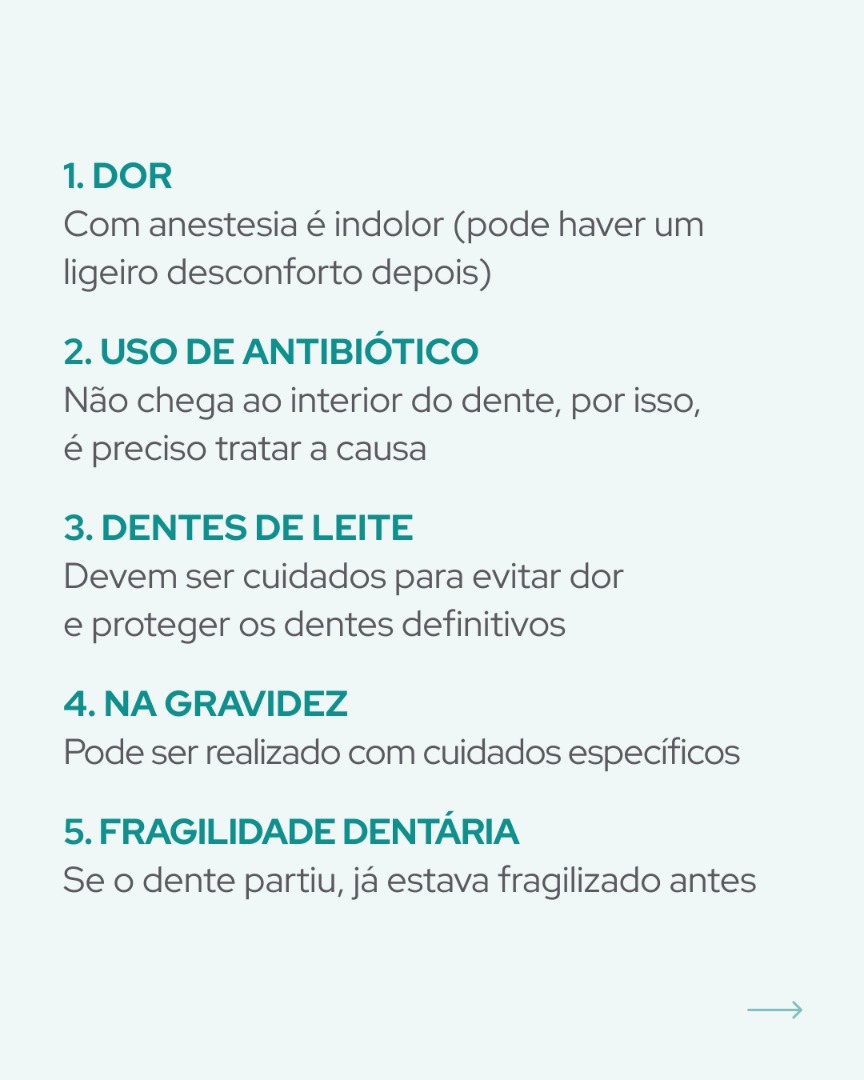
Root canal treatment is painful: With the use of local anaesthetic, the treatment is painless. After the procedure, it is normal to experience some discomfort for the first few days, which can be managed with medication.
-
Can I not just take an antibiotic and solve the issue? The cause of the infection is inside the tooth, in the infected or necrotic pulp. This area has little to no blood circulation, so the antibiotic cannot reach it. What the antibiotic does is relieve symptoms and reduce inflammation around the tooth, but the solution requires removing the causal factor through a root canal treatment.
-
It is not worth doing a root canal on baby teeth, as they will fall out anyway: if a child is in pain, it should be relieved, even if it is a baby tooth. Furthermore, bacteria can spread to the bone and damage the structure of the permanent tooth that is yet to erupt.
-
Root canal treatment is not safe during pregnancy: keeping infected tissue in the body can harm the health of both the mother and the fetus. Therefore, endodontic treatment is recommended, requiring only a few extra precautions (when taking X-rays and administering drugs and medications).
-
The tooth breaks because it had a root canal: when a treated tooth breaks, it is not due to the endodontic treatment itself, but rather to the fragility the tooth already showed before the procedure (large cavities or a fractured tooth crown). For severely damaged teeth, placing a crown after treatment is recommended to increase resistance to fracture.
-
The root canal is poorly done and becomes infected again: when a treated tooth shows symptoms again, most of the time the treatment failure is not due to clinical error, but rather to a new contamination (due to a tooth fracture, a fractured restoration, or a new cavity, which allow bacteria to re-enter). A treated tooth is not an immaculate tooth and deserves attention and maintenance care.
Endodontic treatment turns out to be the simplest and most effective way to preserve the tooth, removing the focus of infection and pain, avoiding its extraction and prolonging its life. Ultimately, rather than fearing root canal treatment, perhaps it is time to make peace with it after all, it is a treatment far friendlier to your smile than fear ever was.
Content developed by Dr Adriana Pires, OMD 12858 General Dentist, specializing in Endodontics
25, May 2026