






Appointments
Request Appointment/Request Exam - After completing the respective forms, these requests will be processed by our services, and you will receive confirmation by email. The indications about the Agreements (Insurance/Subsystem) are merely informative, please request confirmation in the "Observations" field.
Schedule Appointment/Exam myHPA - By accessing myHPA Saúde you can make the appointment in real time, directly on the Doctor's schedule according to his availability.
You can also contact us at +351 282 420 400 Algarve | +351 269 630 370 Alentejo | +351 291 003 300 Madeira
Phone booking/service hours:
Monday to Friday: 8:00 AM to 7:00 PM, Saturday: 8:00 AM to 5:00 PM Sunday and Holidays: Closed
(National landline)
Your request has been successfully received. We will confirm your appointment shortly.
Download myHPA Saúde:


HPA Health Group Newsletter:
Subscribe and stay up to date with all the news!
Haemorrhoids
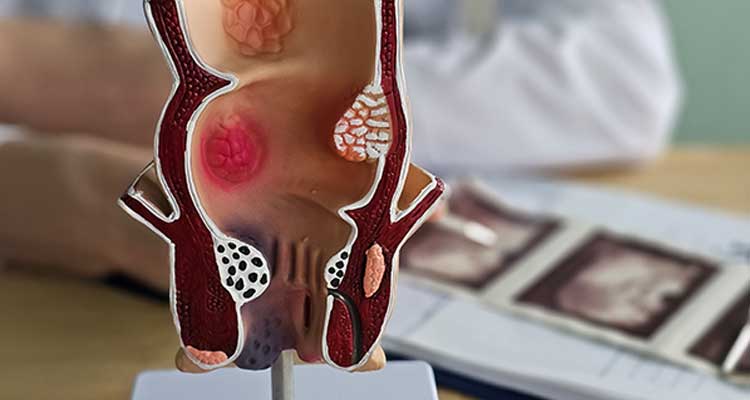
Haemorrhoids are dilated veins located in the lower rectum and anus. They may be internal, developing inside the anus, or external, located in the skin around the anus. In some cases, both types coexist.
External haemorrhoids are often easier to manage and may resolve spontaneously. Internal haemorrhoids can be more problematic and may require more intensive treatment, including, in some cases, surgical removal.
Signs and symptoms of haemorrhoids
External:
- Anal itching or irritation;
- Pain and discomfort;
- Bleeding;
- Possible clot formation (thrombosed haemorrhoids).
Internal:
- Pain and irritation during bowel movements;
- Bleeding;
- Prolapse of the haemorrhoid, which in severe cases may cause intense pain.
Haemorrhoids develop due to sustained pressure in the lower rectum. Common contributing factors include:
- Straining during bowel movements, often associated with constipation;
- Prolonged sitting;
- Chronic diarrhoea;
- Heavy lifting or intense physical effort;
- Pregnancy;
- Obesity;
- Ageing;
- Genetic predisposition.
Diagnosis is primarily based on the patient’s clinical history and physical examination, including digital rectal examination. Additional investigations may be performed when necessary.
Treatment depends on severity and type and may be divided into three levels.
Conservative management includes a high-fibre diet, adequate fluid intake, prevention of constipation, use of cushions when sitting for long periods and maintenance of good anal hygiene, such as sitz baths.
Pharmacological treatment may include topical creams or suppositories containing corticosteroids to reduce inflammation, oral or topical analgesics for pain relief and laxatives in cases of persistent constipation.
Non-surgical treatment includes rubber band ligation or injection of sclerosing agents, which may be effective in mild to moderate haemorrhoidal disease.
In more severe cases, when previous treatments are ineffective, surgical intervention may be required.
Continuous medical follow-up is essential, and no treatment should be initiated without appropriate clinical guidance.
- Dra. Ana Margarida Vieira
- Dr. André Sancho Ramos
- Dr. Bruno Peixe
- Dra. Helena Tavares de Sousa
- Dra. Maria Margarida Sampaio
- Dra. Patrícia Queirós
- Dra. Ana Rita Herculano
- Dr. André Sancho Ramos
- Dr. Diamantino Sousa
- Dr. Francisco Açucena
- Dr. Horácio Guerreiro
- Dr. Mário César
- Dr. Horácio Guerreiro
- Dra. Ana Rita Herculano
- Dra. Carla Sousa Andrade
- Dra. Isabel Jardim
- Dra. Joana Carvão
- Dr. Luís Jasmins
- Dr. Nuno Ladeira
- Dra. Rosa Neto da Silva
- Dr. Vítor Magno Pereira