






Appointments
Request Appointment/Request Exam - After completing the respective forms, these requests will be processed by our services, and you will receive confirmation by email. The indications about the Agreements (Insurance/Subsystem) are merely informative, please request confirmation in the "Observations" field.
Schedule Appointment/Exam myHPA - By accessing myHPA Saúde you can make the appointment in real time, directly on the Doctor's schedule according to his availability.
You can also contact us at +351 282 420 400 Algarve | +351 269 630 370 Alentejo | +351 291 003 300 Madeira
Phone booking/service hours:
Monday to Friday: 8:00 AM to 7:00 PM, Saturday: 8:00 AM to 5:00 PM Sunday and Holidays: Closed
(National landline)
Your request has been successfully received. We will confirm your appointment shortly.
Download myHPA Saúde:


HPA Health Group Newsletter:
Subscribe and stay up to date with all the news!
Abdominal Wall Hernia
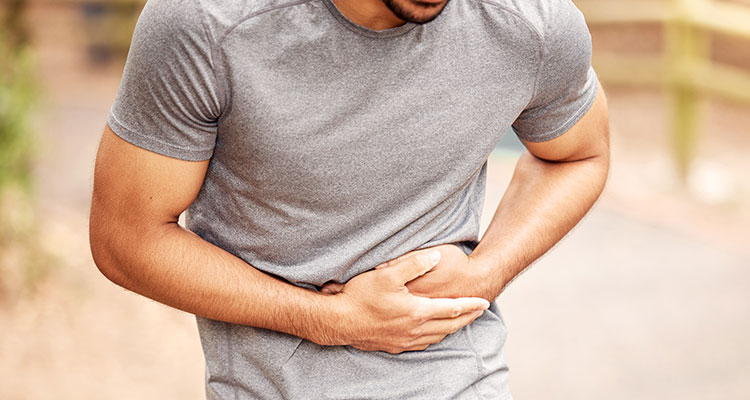
An abdominal wall hernia is defined as the protrusion of organs or part of them through an opening or defect in the abdominal muscles. This condition can occur spontaneously due to natural weakness of the abdominal wall, or it may be associated with factors that increase intra-abdominal pressure, such as chronic coughing, intense physical exertion, constipation, obesity, or pregnancy.
Types of Hernias:
- Inguinal Hernia – Located in the groin area.
- Umbilical Hernia – Located around the navel.
- Femoral Hernia – Found just below the groin.
- Epigastric Hernia – Located along the midline of the upper abdomen (linea alba).
- Incisional Hernia – Occurs at the site of a previous surgical incision.
There are also complex hernias, which may involve large defects, multiple recurrences, intestinal fistulas, or less common locations.
Symptoms and Complications
Common symptoms include local pain or discomfort, which can worsen during physical activity. In most cases, the condition progresses slowly without immediate complications, allowing careful surgical planning. However, incarcerated hernias, where the protruded tissue cannot be pushed back into the abdominal cavity, can occur and require urgent surgical treatment to prevent serious complications.
Expert Care at HPA Saúde Group
At HPA Saúde Group, we provide specialised care for the diagnosis, monitoring, and treatment of all types of abdominal wall hernias, using innovative surgical techniques, often minimally invasive.
Most surgeries for primary hernias, such as inguinal or umbilical hernias, can be performed on an outpatient basis, allowing patients to return home the same day. This approach increases comfort and safety while reducing the risk of complications associated with prolonged hospital stays.
For complex hernias, treatment requires a multidisciplinary approach and a team experienced in abdominal wall reconstruction. These advanced procedures aim to restore functional integrity, improve stability, and reinforce weakened structures. At HPA Saúde Group, we coordinate care among specialists in nutrition, physiatry, anaesthesiology, and internal medicine to optimise pre- and post-operative outcomes and maximise surgical success.
Comprehensive Hernia Consultation
Our dedicated abdominal wall hernia consultation focuses on a thorough patient assessment and careful planning of the therapeutic strategy. Patients receive close and continuous follow-up before and after surgery to ensure a safe, effective, and rapid recovery, while minimising the risk of recurrence.
Did You Know?
? Hernia repair surgery is one of the most commonly performed surgical procedures worldwide.
? Abdominal wall hernias are extremely common, particularly in men, who are about eight times more likely to develop them. They most frequently occur between the ages of 50 and 70.
? Among abdominal wall hernias, the most prevalent is the inguinal hernia, with 96% located in the groin area and only 4% in the femoral region.
? Abdominal hernias can be congenital (present at birth) or develop due to obesity, pregnancy, constipation, chronic cough, or excessive physical strain.
? Large or massive hernias may extend towards the testicles and are known as inguinoscrotal hernias. Many patients are born with this deformity, which may only become apparent in adulthood as muscle weakness develops.
? Many hernias are asymptomatic, but some can become incarcerated or strangulated, causing pain or discomfort and requiring urgent surgical correction.
?Strangulated hernias are ischaemic (lacking blood supply) and can lead to intestinal ischaemia, perforation, or peritonitis due to tissue death and infection.
? The only effective treatment for abdominal hernias is surgery, either through traditional open methods or laparoscopic techniques. All hernias should be surgically repaired to prevent complications such as strangulation.
- Dra. Ana Fazenda
- Dra. Inês Guerreiro
- Dr. José Luís Ferreira
- Dr. Juan Rachadell
- Dr. Paulo Martins
- Dr. Paulo Vieira de Sousa
- Dr. Carlos Garrido Rodrigues
- Dra. Inês Guerreiro
- Dra. Isabel Nascimento
- Dr. João Maia Teixeira
- Dra. Mercedes Sanchez Sanchez
- Dra. Nicole Cardoso
- Dr. Nogueira da Costa
- Dr. Paulo Vieira de Sousa
- Dr. Rúben Martins
- Dra. Ana Fazenda
- Dr. José Dias
- Dr. José Luís Ferreira
- Dr. Paulo Martins
- Dra. Inês Guerreiro
- Dr. Paulo Vieira de Sousa
- Dr. Paulo Martins
- Dr. António G. Folgado
- Dr. Diogo de Sousa
- Dr. Fernando de Jesus Fernandes
- Dr. Miguel Allen
- Dr. Gabriel Gomes
- Dra. Mariana Claro
- Dra. Ana Catarina M. Rodrigues
- Dr. Miguel Reis
- Dr. Paulo Vieira de Sousa
- Dr. Pinto da Cruz
- Dr. Ricardo Viveiros
- Dra. Rubina Almada Gouveia
- Dra. Maria Gomes
- Dr. Miguel Reis
- Dr. Pinto da Cruz
- Dra. Rubina Almada Gouveia