






Appointments
Request Appointment/Request Exam - After completing the respective forms, these requests will be processed by our services, and you will receive confirmation by email. The indications about the Agreements (Insurance/Subsystem) are merely informative, please request confirmation in the "Observations" field.
Schedule Appointment/Exam myHPA - By accessing myHPA Saúde you can make the appointment in real time, directly on the Doctor's schedule according to his availability.
You can also contact us at +351 282 420 400 Algarve | +351 269 630 370 Alentejo | +351 291 003 300 Madeira
Phone booking/service hours:
Monday to Friday: 8:00 AM to 7:00 PM, Saturday: 8:00 AM to 5:00 PM Sunday and Holidays: Closed
(National landline)
Your request has been successfully received. We will confirm your appointment shortly.
Download myHPA Saúde:


HPA Health Group Newsletter:
Subscribe and stay up to date with all the news!
Skin Cancer
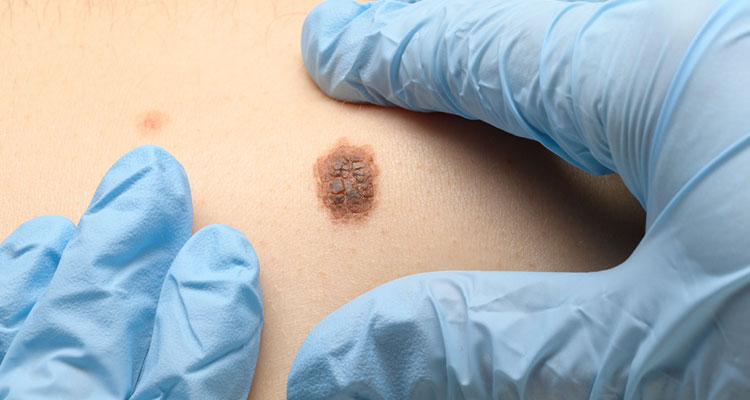
Skin cancer is caused by the abnormal and uncontrolled growth of the cells that make up the skin. These cells are arranged in layers, and depending on the affected layer, different types of cancer are defined. The most common are basal cell carcinoma and squamous cell carcinoma. Rarer and more lethal than these carcinomas is melanoma, the most aggressive type of skin cancer.
Ultraviolet (UV) radiation is the main factor responsible for skin tumours, with most cases associated with excessive sun exposure or the use of tanning beds. Although non-melanoma skin cancers are common, they have low lethality and can be easily cured if detected early. Regularly examine your skin and consult a dermatologist immediately if you notice suspicious moles or spots.
Melanoma has the worst prognosis and highest mortality rate. While a melanoma diagnosis often causes fear and anxiety, the chances of cure are over 90% if the disease is detected early. Melanomas usually appear as a mole or spot on the skin, in brown or black shades. However, melanomas often change colour, shape, or size, and may bleed. It is therefore important to monitor your skin constantly and consult a dermatologist immediately if any suspicious lesions appear.
Even without visible signs, it is recommended to visit a dermatologist at least once a year. Some lesions may appear in areas difficult to see by the patient, and a lesion considered “normal” by the individual may be suspicious to the doctor.
People with fair skin, phototypes I and II, are at higher risk, although melanoma can also occur in darker-skinned individuals, albeit less frequently. Melanoma originates from melanocytes, the cells that produce melanin, the pigment that gives skin its colour. It usually develops in areas most exposed to the sun. In its early stages, melanoma is limited to the upper skin layers, making surgical removal and cure more feasible. In advanced stages, the lesion is thicker and deeper, increasing the risk of metastasis and reducing treatment success.
Early diagnosis is therefore essential. Metastatic melanoma generally has a poorer prognosis and fewer treatment options. Family history also plays a key role, so relatives of melanoma patients should undergo regular preventive checks, as risk increases with cases in first-degree relatives.
- Dr. André Laureano
- Dr. Carlos Clerins
- Dra. Virginia Coelho de Sousa
- Dra. Christine Schoutens
- Dra. Christine Schoutens
- Dra. Bárbara Roque Ferreira
- Dra. Cristina da Silva Sousa
- Dr. De Lorenzo
- Dr. Vitor Neto
- Dr. Bruno Duarte
- Dr. João Sousa
- Dr. Pedro Vale Fernandes